
Democratic Reforms at Risk Without Continued Pressure on Military
(Washington, DC) – The US government should keep in place sanctions on Burma to deter the Burmese military from derailing democratic reforms, Human Rights Watch said today. Human Rights Watch has learned that the Obama administration plans to announce the lifting of key sanctions during Burmese leader Aung San Suu Kyi’s visit to Washington, DC, which begins on September 14, 2016.
“US sanctions are focused on the Burmese generals and their cronies in order to encourage democratic reforms,” said John Sifton, Asia advocacy director at Human Rights Watch. “The sanctions are crucial for pressing the military to end rights abuses and transfer power to a fully civilian government. They shouldn’t be fully lifted until the democratic transition is irreversible.”
Many of the sanctions restricting Burmese financial institutions, imports, and US investment in Burma were already eased or removed entirely between July 2012 and May 2016. Most of the remaining sanctions specifically target the Ministry of Defense, state or non-state armed groups, and individuals and entities on the US Department of Treasury’s “Specially Designated Nationals” (SDN) List.
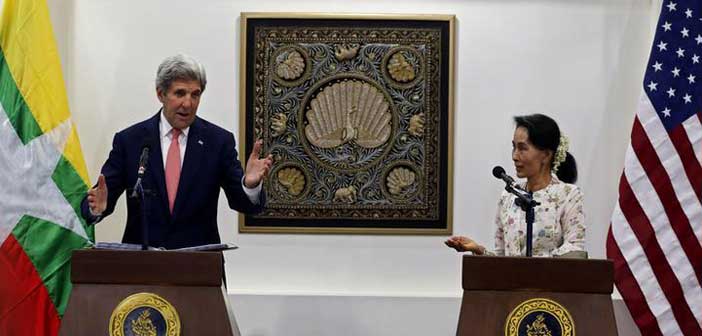
During a joint news conference on May 22, 2016, Suu Kyi, State Counsellor and Foreign Minister of Burma, and US Secretary of State John Kerry both appeared to suggest that relaxing sanctions would not occur until Burma’s military allowed the country’s fundamentally flawed 2008 Constitution to be revamped. The constitution reserves 25 percent of parliamentary seats for the military, empowers the military to appoint the ministers of defense, home affairs, and border affairs, and allows the military to dissolve the government during a national emergency.
Kerry said at the May news conference that “the key to the lifting of the sanctions is really the progress that is made within Myanmar in continuing to move down the road of democratization… it’s very difficult to complete that journey – in fact, impossible to complete that journey with the current constitution. It needs to be changed.”
Suu Kyi said: “We’re not afraid of sanctions. We’re not afraid of scrutiny… I understand and I accept and I believe that the United States is a friend, and are not keeping the sanctions to hurt us, but to – that it would help us. And I’m ready to accept that; I’m not afraid of sanctions.”
Core sanctions include the gem trade, with which the Burmese military has long been involved in illicit and abusive exploitation, Human Rights Watch said. Key provisions in the current sanctions regime aim to prevent US companies and individuals from doing business with military officials and military-owned enterprises, prohibit the import of Burmese jade and gemstones into the United States, and restrict businesses and persons from involvement in that sector. Recent legal reforms in Burma that address the jade and gemstone sector have not yet been fully implemented. As a result, on August 23, US Customs and Border Protection reportedly updated and renewed its rules prohibiting the importation of gemstones from Burma.
The US Department of the Treasury maintains on its “Specially Designated Nationals” (SDN) database an extensive number of Burmese people and entities with whom US companies and persons are barred from doing business. Several are individuals who the US has determined threaten the peace, security, or stability of Burma’s political reforms, or are responsible for or complicit in human rights abuses in Burma.
“Many of the Burmese on the US sanctions list are criminal suspects and human rights abusers,” Sifton said. “The US should assist Burma in promoting genuine economic development, not help those who made ill-gotten gains during military rule.”
Human Rights Watch also urged the Obama administration to keep in place the underlying “state of emergency” that allows many parts of the sanctions regime to stay in place. If current executive orders imposing sanctions are lifted or amended, they should be replaced with a new executive order under which sanctions could be re-imposed.
Congress has long played an important role in imposing and maintaining sanctions on key human rights abusers in Burma, particularly those related to the Jade and gem sector. Regardless of administration actions, the United States Congress should continue its leadership and maintain relevant sanctions legislation, which will be particularly useful in the event of backsliding on reforms by the Burmese military.
The US and other donors should also press for fiscal transparency in connection with Burma’s mineral sector and state- or military-owned enterprises, Human Rights Watch said. All donors and international financial institutions such as the World Bank and Asian Development Bank should make revenue transparency a prerequisite for budget support to Burma and investments in the extractives industries.
The US and other governments should retain restrictions on military assistance and training, and make increases in bilateral and multilateral assistance conditional on key reforms and military withdrawal from civilian government.
“Sanctions were always intended to press the Burmese military to relinquish power and embrace reforms,” Sifton said. “Now that real progress has been made, it’s crucial to keep up the pressure until those goals have been achieved.”
 Equality Myanmar (EQMM) is a leading nongovernmental organization that organises a wide range of human rights education and advocacy programs, the documentation human rights violations, and provides emergency support for activists, human rights defenders, and their families. We work with a range of local civil society organizations, educators, activists, various local actors, and our programs and activities reach all states and regions in Myanmar.
